Low Water Pressure in Your Home? How to Find the Cause
A shower that has turned to a trickle is trying to tell you something. Whether it is one fixture or the whole house narrows the cause fast — and tells you what is safe to check yourself before you call.
The fast answer: one fixture or the whole house?
Low water pressure is a symptom, not a diagnosis, and the first question sorts almost every case. If only one faucet or shower is weak, the problem lives at that fixture — a clogged aerator, a scaled showerhead or a partly closed local valve. If every fixture is weak, the problem sits upstream, before the water splits off to individual rooms: a valve not fully open, a failing pressure regulator, corrosion narrowing your pipes, a hidden leak, or the main water line from the street. Run a bathroom faucet, the kitchen tap, then an outside hose bibb, and note whether the drop was sudden or gradual — those two timelines point to very different causes.
Start at the fixture: aerators, showerheads and local valves
For a single weak faucet, unscrew the aerator — the small mesh cap at the tip — and rinse out the grit and mineral flakes trapped in it; in Maryland homes with hard water, that screen fills faster than most people expect. A weak shower often has the same story inside the showerhead, where mineral scale narrows the spray holes: removing and soaking the head, then clearing the holes, restores many showers. Next, check the local shut-off valves under the sink. Valves turned for an earlier repair are often left half-open, quietly throttling the whole fixture. Check flexible supply lines for kinks, too. If cleaning and opening the valves fully restores the flow, you are done.
The two valves and the regulator most homeowners forget
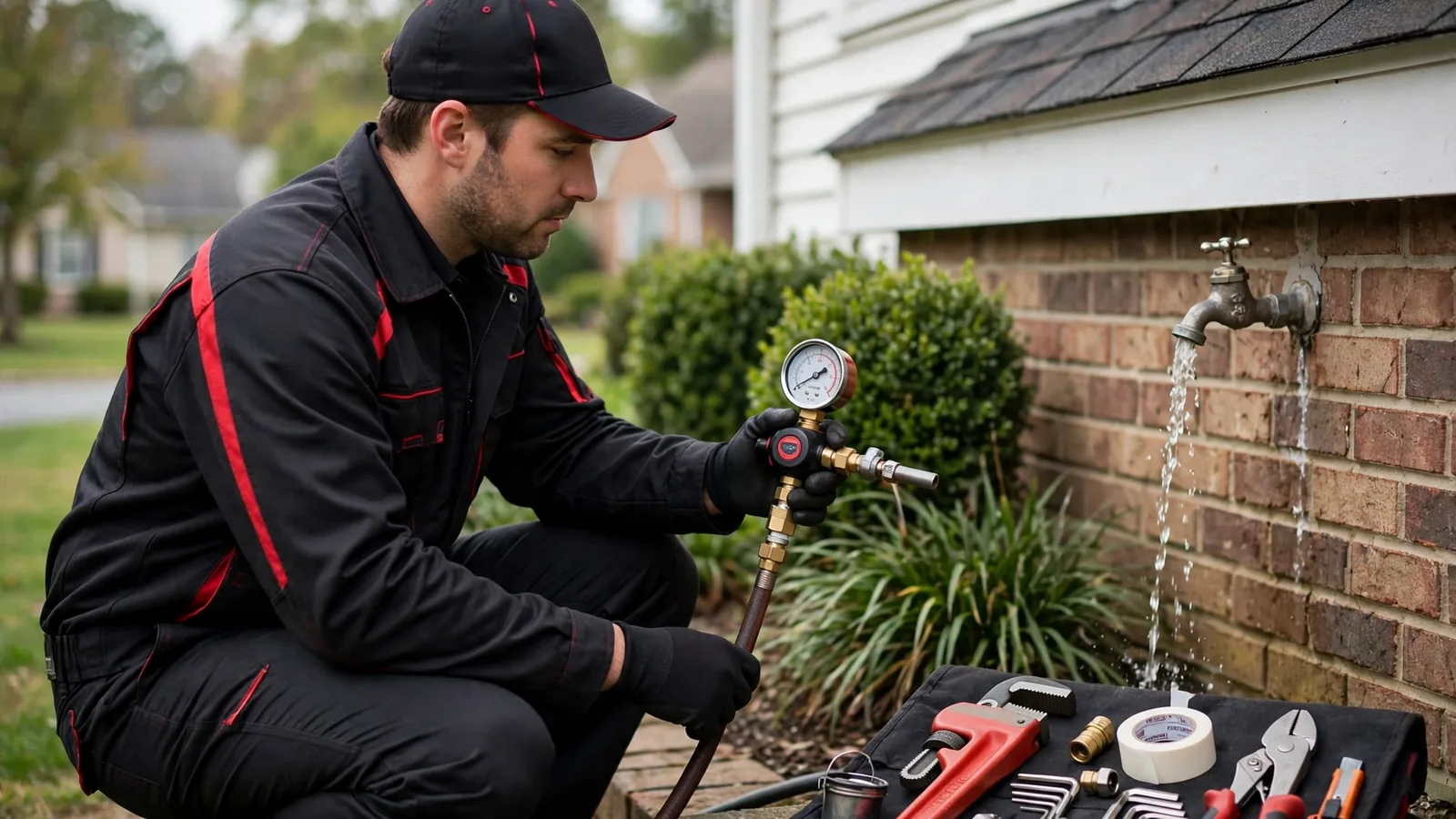
When the whole house is weak, start where the water enters it. The main shut-off valve — usually where the line enters the basement, near the front wall or by the meter — must be fully open; a valve left a quarter-turn short after any plumbing work limits every fixture at once. Many homes also have a pressure-reducing valve, a bell-shaped fitting on the main line that keeps street pressure at a safe level indoors. These regulators wear out, and one failing closed lets less water through every season. A gauge screwed onto a hose bibb gives a real number, and comparing the reading at rest against the reading while a tub fills separates a supply problem from a flow problem — the distinction our water line services visit is built to make.
When low pressure is the first sign of a hidden leak
Treat a sudden pressure drop as a warning until you have ruled out a leak. Water escaping from a cracked main line, a joint inside a wall or a line under a slab never reaches your fixtures — pressure falls because the system is feeding a hole as well as your taps. Companion signs: a bill rising with no change in use, a damp or warm patch on a floor or wall, a soggy strip of yard along the line from the meter, and running-water sounds when everything is off. Try the meter test: with all taps and appliances off, note the reading, wait an hour or two, and read it again. If it moved, water went somewhere. That pattern belongs to leak detection work — finding the escape first prevents a small washout from becoming a repair plus drywall and flooring.
Corrosion and buildup: the slow cause in older homes
If pressure has been fading for years in an older home, the cause is often inside the pipes. Galvanized steel lines, common in houses built decades ago across Beltsville, Laurel, Hyattsville and Silver Spring, rust from the inside out. The pipe does not need to leak to fail you: its internal diameter simply shrinks until a shower upstairs is a negotiation. Clues are pressure worst at the highest fixtures, rusty water after taps sit unused, and a pinhole leak already repaired somewhere. Hot-only low pressure points elsewhere — toward the water heater and hot runs, where sediment and scale restrict hot flow while cold stays strong. Where corrosion is advanced, repiping the failing run, or the whole home in stages, restores pressure in a way no cleaning can, because the pipe itself is the restriction.
Could the problem be outside your house?
Before you blame your own plumbing, ask a neighbour: is your pressure low too? If the whole street is weak, the cause is likely on the supply side — utility work or a break further up the network — and your job is to wait, then clean your aerators once pressure returns. If your neighbours are normal, the problem sits between the street and your fixtures, on your side of the meter. A partly failed service line behaves this way: a crushed or corroded section may hold pressure at rest, then collapse the flow the moment two fixtures open together. Flow under demand is the test that tells the truth.
What a technician tests — and when to call us
A proper low-pressure visit works from the street inward: pressure at the hose bibb at rest, then under flow; the main valve and regulator; the meter, checked for movement that would betray a leak; then sections isolated one at a time until the weak stretch identifies itself. The fix follows the finding — a clogged fixture or tired regulator is a small job, a leaking main-line section is a targeted repair, and a house full of narrowed galvanized pipe is a conversation about repiping, partial or whole-home. Homes in Beltsville, Laurel, Silver Spring and Columbia reach us with versions of this same complaint. If your pressure dropped suddenly, keeps fading, or comes with a rising bill or damp patch, call Eagle Plumbing at (240) 266-8317 or send the lead form on this site — we will measure first, show you where the water is being lost or throttled, and price the repair that fits before any work begins.
Need Help With This?
Our related service: Water Line Repair & Replacement — Main water line repair and replacement — we find underground leaks, restore pressure and replace failing service lines.