Hydro Jetting vs. Snaking: What's the Difference?
Both clear drains — but one punches a hole through the clog while the other scrubs the whole pipe clean. Here's how to know which one your drain actually needs.
What a snake does
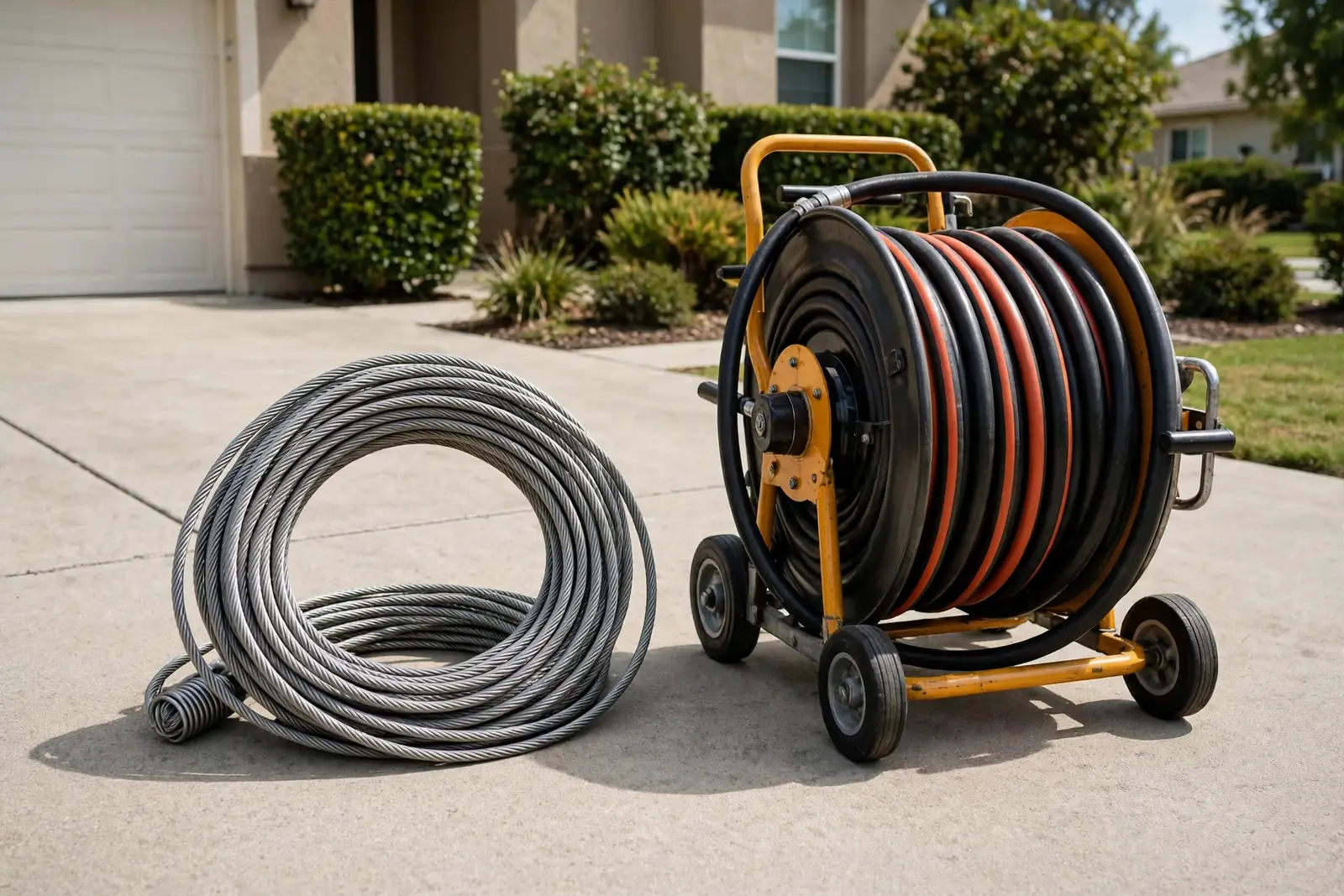
A drain snake (or auger) is a flexible cable fed into the line to break through a blockage. It's quick and effective for a simple, localised clog — a hairball in a bathroom drain, for instance. But it only opens a path through the blockage. The grease, soap sludge and scale coating the rest of the pipe wall stay exactly where they were, which is why some drains clog again a few months later. The tool itself comes in sizes. A hand auger is fine for a single sink or tub trap. For main lines, plumbers use powered drum or sectional machines with different cutting heads — one to punch through a blockage, another to scrape roots or scale. A specialist closet auger is shaped to clear a toilet without scratching the porcelain. All of them share the same limitation: the cable travels down the middle of the pipe. Anything stuck to the walls outside the cable's path is still there when the cable comes out, and the drain that 'works' again is often running at half its real capacity.
What hydro jetting does
Hydro jetting uses high-pressure water to scour the entire inside wall of the pipe. It removes grease and oil, soap sludge, mineral scale, food and paper buildup — and it can cut through tree roots intruding into the line. The pipe isn't just open; it's clean, which restores drainage speed, reduces odours and extends the life of the line.
What happens during a hydro jetting service
A professional jetting job starts with looking, not blasting. We usually run a video camera pipe inspection first to confirm what is in the line and what condition the pipe is in — jetting the wrong pipe, or a pipe that is already cracked, helps no one. The jetter itself is a pump delivering water at several thousand PSI through a reinforced hose. The nozzle matters as much as the pressure: rear-facing jets pull the hose forward through the line while scouring the walls, forward jets cut through the blockage ahead, and rotating nozzles strip grease and scale evenly. The technician works the hose slowly back through the run, often in several passes, flushing loosened debris downstream, then cameras the line again to confirm the walls are clean and the water runs at full speed.
When jetting is the wrong tool
Jetting is powerful, which is exactly why it is not always appropriate. A pipe that is cracked, collapsed, badly offset at a joint, or eaten thin by corrosion needs repair, not pressure — high-pressure water can widen an existing break and turn a contained problem into an excavation. Very old, fragile materials deserve the same caution. This is why the inspection comes first: if the camera shows structural damage, the right sequence is sewer line repair or replacement, with jetting used afterwards, if at all, to clean a sound pipe. Any company willing to jet a line blind, without asking about its age or condition, is skipping the step that protects your property. Our guide to what a camera inspection reveals shows the kinds of damage it catches before they become expensive surprises.
How to choose
A one-off clog in a single fixture? Snaking is usually enough. Frequent backups, slow drains across the whole house, grease-heavy kitchen lines, sewer blockages, persistent drain smells or a high-usage commercial system all point to jetting. The professional answer starts with looking: we evaluate the pipe's condition first, because older or damaged lines need a method matched to what they can handle.
How long the results last
A properly jetted line, with the walls scrubbed back to the pipe surface, typically stays clear far longer than a snaked one — often years rather than months — because new buildup has a smooth surface to start from. How long it lasts in practice is mostly about what goes down the drain afterwards. Kitchen lines re-grease fastest: cooking oil poured down the sink, even chased with hot water, coats the walls again within months. Strainers in sinks and showers, grease wiped into the trash instead of the drain, and no 'flushable' wipes anywhere in the system stretch the interval a long way. High-use properties plan around it instead: restaurants and commercial kitchens usually jet on a fixed schedule — quarterly or twice a year — because a backup during service costs far more than maintenance, and homes with a known problem line often do the same on an annual cycle.
What affects the cost of clearing a drain
The honest drivers are access, distance and cause. A line with a proper outdoor cleanout is quick to work on; one that requires pulling a toilet or going through a roof vent takes longer. A short branch line costs less than jetting a full main out to the street. A simple grease clog clears faster than dense root intrusion, and a camera inspection bundled into the visit adds information that can prevent paying twice for the same problem. What you should expect from any quote is that it follows a look at your actual line — the method and the price both depend on what is in the pipe.
The bottom line
Snaking is a reset button; jetting is a deep clean. If you keep paying to clear the same drain, the problem is the buildup — and that's the problem jetting solves.
Need Help With This?
Our related service: Hydro Jetting — High-pressure water cleaning of the entire pipe wall — removes grease, scale, roots and sludge that snaking leaves behind.